
LASIK Technology and Surgical Procedure
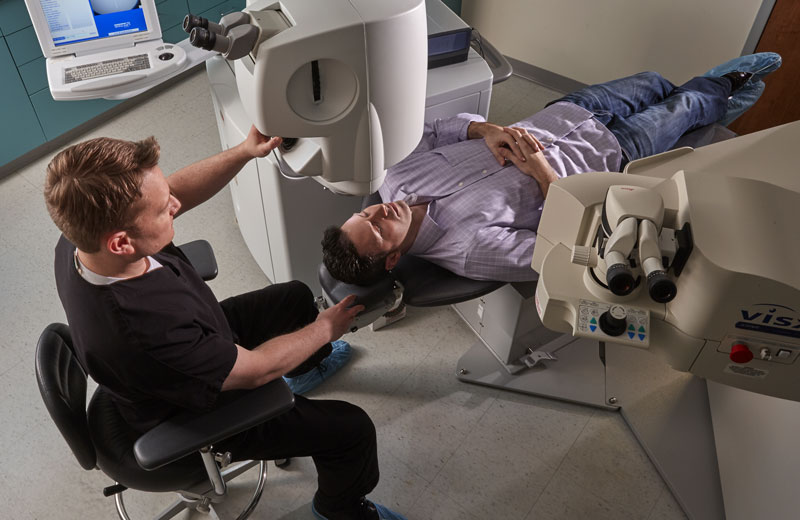
Our Visx CustomVue Wavefront-guided S4IR LASIK technology guarantees the best measurement of your eye and, therefore, the best treatment.
Just like no two fingerprints are exactly the same, the optics of each eye are unique. Our technology has the ability to measure your unique optical characteristics to calculate the perfect treatment for each eye.
What if my eye moves during surgery?
Patients are often concerned that eye movement during surgery might ruin their treatment. We have two special technologies to prevent any eye movement from causing a problem:
- Iris Registration technology identifies your iris based on your pre-surgical scan and then rotates treatment to exactly match your eye.
- Tracking technology directs the laser to precisely follow your small eye movements during the treatment. If your eye moves out of range, the laser stops until your eye returns to the correct position.

What happens before surgery?
Your pre-surgical evaluation is a two-hour comprehensive examination of your eyes, including a computerized wavefront scan to guide the laser treatment. This scan will provide comprehensive, individual diagnostic information so the exact treatment can be calculated.
The Lasik surgery process
One hour before the procedure, you’ll apply antibiotic drops to avoid infection and you take a Valium to relax.
During the procedure, you lie comfortably on your back and your eye is numbed with drops. The surgery takes place in three steps:
Step 1. Your surgeon places a small suction ring on your eye. You feel a slight pressure. Next your surgeon docks a laser cone in the suction ring, then uses high-speed pulses from our advanced 60 kHz laser to separate layers of your cornea at a precise depth. This creates an ultra-thin flap on your cornea. Your surgeon then removes the suction. This all takes about 30 seconds. Next, your surgeon puts a sterile drape over your eye and inserts a speculum to prevent blinking. With the numbing, you won’t feel the need to blink.
Step 2. Your surgeon gently lifts the tiny flap and uses our Visx CustomVue S4IR laser vision correction technology, guided by information from your pre-surgical scan. As the laser shapes your cornea to correct your vision imperfections, you feel nothing in your eye.
Step 3. The reshaping takes less than a minute. Then your surgeon lowers the corneal flap and puts antibiotic drops in your eye. The flap heals quickly without discomfort.
After your surgery
Afterward, you keep your eyes closed for four hours and wear clear shields over your eyes until morning. You may feel a slight burning sensation, which is normal. Before bed that night, apply eye drops. The next morning, remove the shields. Your vision should be good enough to drive to our office for your post-op appointment. You quickly gain sharper sight. For a short while your vision may be slightly hazy, and for a few nights you may experience a halo around bright lights. This will be gone in a few months.
Ask about a free LASIK screening
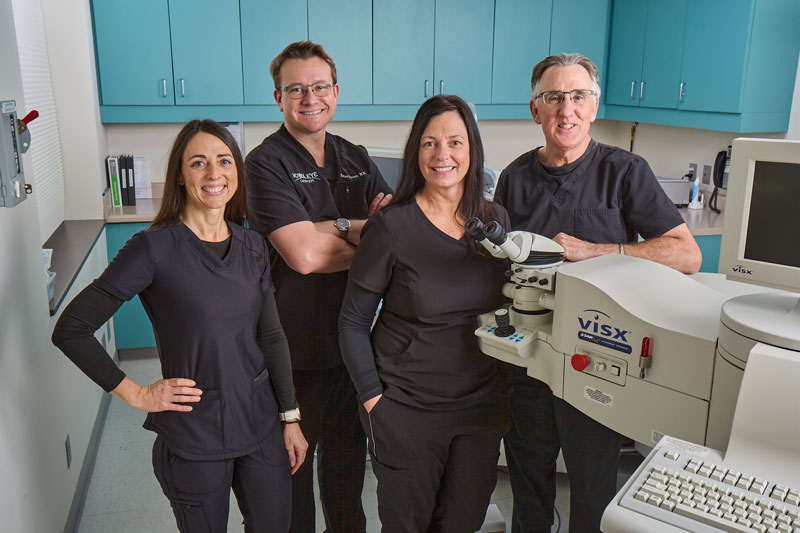
Find out if you’re a candidate for Iowa Eye Center’s LASIK by scheduling a complimentary screening with one of our Refractive Surgery Coordinators at our modern facility. We’ll assess your vision and discuss your medical background and vision expectations.
Call (319) 362-3937 to set up your free screening today.